Introduction
Whenever solar energy is talked about, the image of solar panels comes to mind, but what people often overlook is the vital role played by an inverter. Your home will not be able to use the energy produced by the panels without an inverter.
In this article, we will be providing detailed information about solar inverters, their workings, various types, advantages, and choosing the best one.
What Is a Solar Inverter?
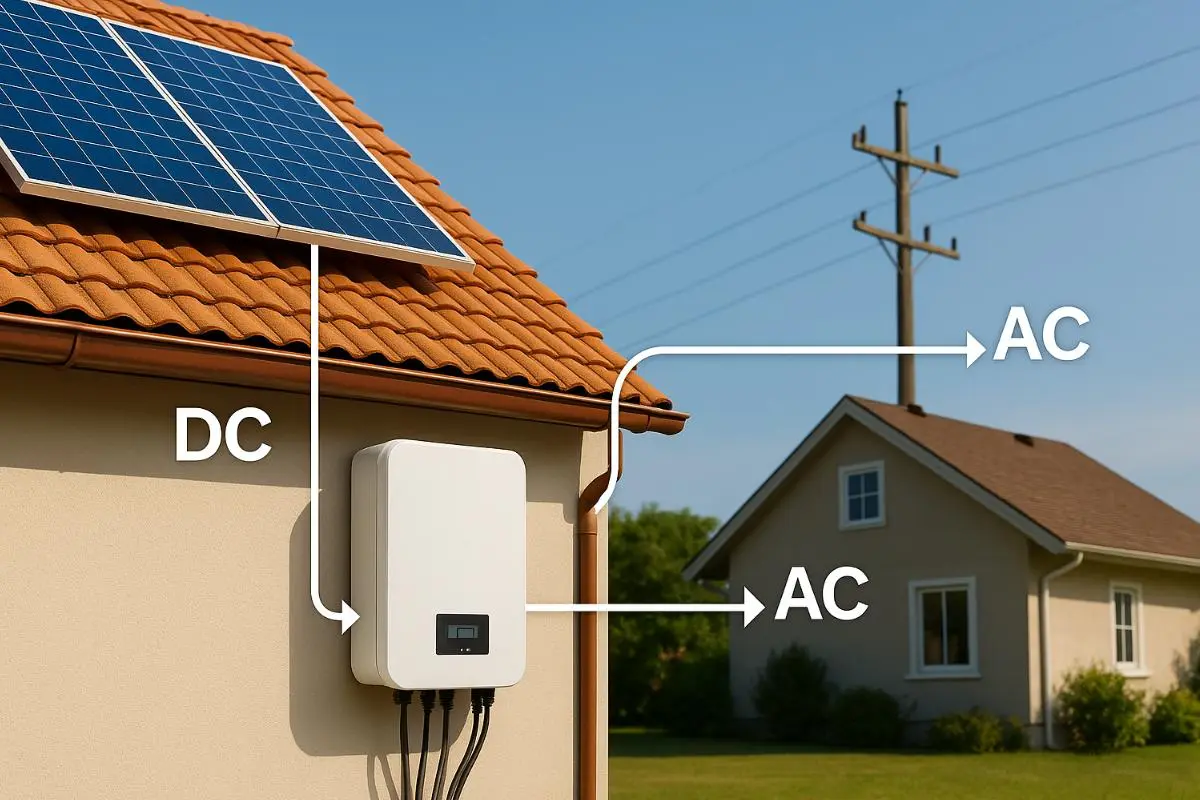
It is an essential electrical apparatus used to convert Direct Current (DC) energy to Alternate Current (AC), which can be used in residential applications.
Simple definition
Solar panels → DC Power → Inverter → AC Power
🔍 Why Are Inverters Needed?
Even though the panels produce power, it would not be useful in your house if there were no inverters for the following reasons:
- Usable energy for domestic uses
- Efficiency and performance monitoring
- Safety and voltage regulation
- Compatibility with the grid (when required)
Types of Solar Inverters
1. String Inverters
This is one of the most affordable options available.
Suitable for: Domestic houses with simple roof designs
Advantages:
- Cost-effective
- Easily installed
Disadvantages:
- If there is shading, energy output drops significantly.
2. Microinverters
Each solar panel has an independent inverter.
Suitable for: Houses with complex roof designs or partial shading.
Advantages:
- Increased efficiency
- Each panel works independently
Disadvantages:
- Expensive
3. Hybrid Inverters
These are used when battery power is required alongside solar panels.
Suitable for: Backup energy systems
Advantages:
- Ability to store energy
Disadvantages:
- High price
4. Central Inverters
These are mainly designed for commercial and industrial applications.
Suitable for: Large scale solar panel arrays
Advantages:
- Capacity
Disadvantages:
- Not recommended for domestic households
⚙️ How Do Solar Inverters Work?
The process of how inverters work is explained below:
- Solar panels collect sunlight
- DC power is generated
- Converts DC to AC using the inverter
- Power is supplied to the house
- Extra energy can either be exported or stored in batteries
Key Advantages of Solar Inverters
🔹 1. Energy Efficiency
Efficiency is achieved due to recent developments in technology.
🔹 2. Monitoring App
Most inverters have an app for monitoring efficiency.
🔹 3. Safety Features
Protective measures against overload and short circuits.
🔹 4. Grid-Friendly
Allows net metering and energy export
How to Pick the Best Solar Inverter
There are a number of things to think about when picking the right inverter:
1. Size of the system
For bigger systems, hybrid or central inverters may be needed.
2. Money
Low budget = String inverter
High performance → Microinverter
3. Roof Design
Microinverters are helpful for roofs that are shaded or have a lot of angles.
4. Needs for batteries
A hybrid inverter is the best choice if you need backup power.
Ratings of Inverter Efficiency
Before you buy, always check the efficiency ratings.
Good efficiency is between 95% and 98%.
More savings = higher efficiency
Tips for Taking Care of Solar Inverters
- Put the inverter in a cool, well-ventilated place.
- Check the system's performance on a regular basis.
- Set up yearly maintenance
- Get rid of dust around the unit.
Why Inverters Are Important for the Future
Inverters are getting smarter and more efficient as more people use solar energy. They are changing the future of renewable energy with features like AI monitoring, battery integration, and smart grid compatibility.
Conclusion
The heart of your solar system is the solar inverter. Choosing the right one can have a big effect on how much energy you save, how well your system works, and how well it works over time.
Whether you're putting in a small home system or a big business system, getting the right inverter will help you get the most out of your solar investment.